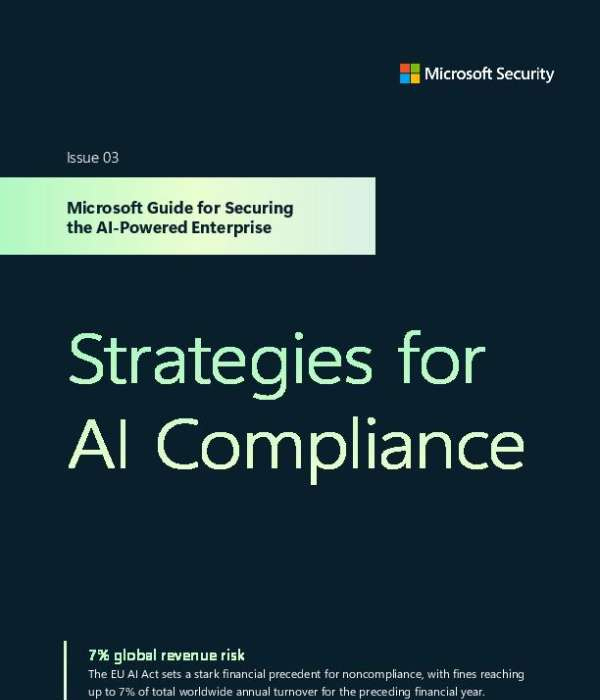
The compliance stakes for AI are now very real and very financial. Under the EU AI Act, noncompliance can lead to fines of up to 7% of your total worldwide annual turnover for the previous financial year. Similar penalty models are being considered in places like South Korea, Colorado, and California, so this isn’t just a European concern.
Key risk areas to focus on include:
- Regulatory coverage and scope
Regulations such as the EU AI Act, GDPR, the Data Act, DORA, NIS2, and the Cyber Resilience Act can apply even if you’re not based in those regions, as long as your AI systems are used there. You also need to watch emerging state-level and regional AI laws (for example, in US states like California and Colorado).
- Data protection and documentation
The EU AI Act requires organizations to maintain technical documentation for 10 years. That makes robust data retention, access control, and documentation practices essential, not optional.
- Privacy and security failures
Regulators are already enforcing existing laws. A recent case saw an AI chatbot company fined €5 million for GDPR violations, including weak legal justification for data processing, poor privacy policies, and inadequate age verification.
- High-risk AI use cases
Systems that significantly affect people’s lives—such as AI for hiring, lending, or education—are often treated as high risk. These require stronger controls around bias, transparency, and human oversight.
To manage these risks, organizations are increasingly adopting a risk-based approach: classifying AI systems by risk level (unacceptable, high, limited, minimal), aligning with baseline frameworks like the EU AI Act and GDPR, and building a governance model that integrates privacy, fairness, transparency, accountability, and security from the start.




 Sign in with LinkedIn